Saturday, December 5, 2009

Coupland Civic Organization holds first event at newly restored historic Depot


Halloween Party at Coupland Depot

Congratulations to the Coupland Civic Organization! Work on the historic Coupland Depot is completed, and the CCO was able to host a community Halloween party at the Depot. Next up will be repairing the caboose that sits next to the Depot. Eventually, the CCO hopes to build a pavilion for community gatherings on the Depot grounds.

The CCO is raising funds for the caboose work by selling personalized pavers that will become part of the sidewalk leading from the street to the Depot. To buy a personalized paver in honor or memory of a person, or in honor of a family or business, get a paver order form on the CCO website:


Wednesday, November 25, 2009

Lone Star Rail hopes to move UP freight to Coupland area

The Statesman’s Ben Wear has provided an update on moving freight rail out of Austin to the Coupland area to make way for passenger rail on Union Pacific’s Austin line. Here’s the link to his column “A rail district by any other name still needs money.”

http://www.statesman.com/news/content/news/stories/local/2009/11/09/1109wear.html

Recently, the Austin-San Antonio Intermunicipal Commuter Rail District held a news conference to announce that they have changed their name to the Lone Star Rail District.

Wear notes, “[T]he train service is still mostly a line on a map. As agency board chairman Sid Covington says, the main obstacles to creating a commuter line between Austin and San Antonio are now and always have been Union Pacific freights and money. . . . To make commuter rail viable, almost all of Union Pacific's freight runs would have to be moved to new or refurbished tracks east of the existing tracks.”

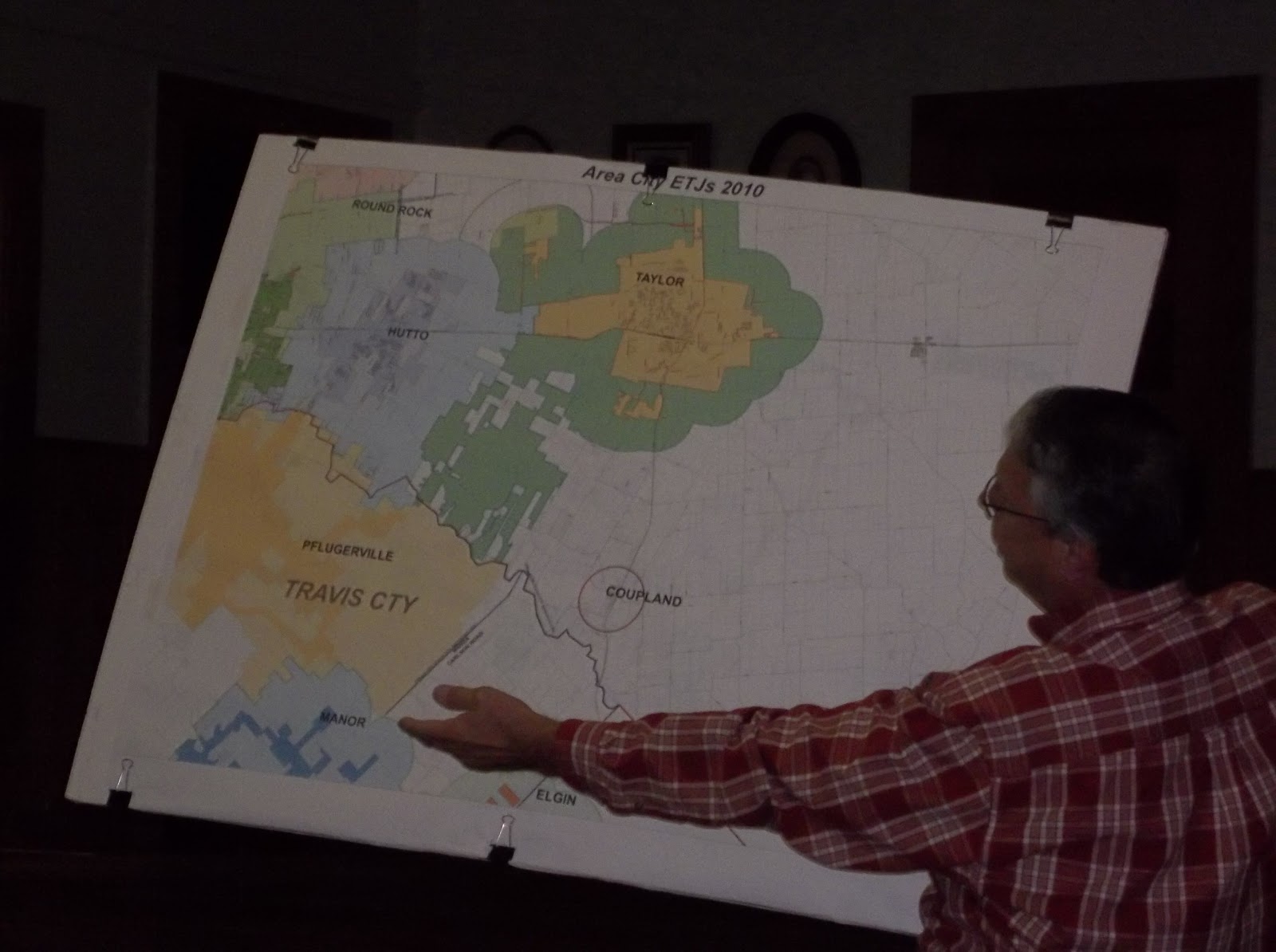
The 2008 Central Texas Rail Relocation Study shows two alternatives for the freight rail—expanding the rail line that goes through Coupland or constructing a new line from Taylor to San Antonio through the countryside west of Coupland. Wear points out, “Rerouting the Union Pacific trains from Taylor . . . would cost anywhere from almost $900 million . . . to $2.4 billion. The rail district last year was saying that construction of the line itself would take another $600 million.”

The Lone Star Rail District hopes that TxDOT and Union Pacific will pay for the alternate freight route.

Wear reports, “As for the passenger rail construction — 16 stations, trains, track and signal improvements, maintenance facilities — Lone Star officials see TxDOT paying half, the other half split roughly in thirds among governments in the Austin area, Bexar County and Comal and Hays counties.”

Right now, there is no money for this construction. What is new now is the Rail District will receive $40 million from the Capital Area Metropolitan Planning Organization and the San Antonio Metropolitan Planning Organization for design work and the environmental process. Wear says that these studies will begin early in 2010.

Saturday, November 21, 2009

Don't squander groundwater resources in Eastern Central Texas

Following the article in the Austin American-Statesman on November 10 that was the subject of our previous post, the paper ran coverage on November 18 of a second large pipeline planned to bring water from the east to the San Marcos area, “Looking east for a water supply.”

Yesterday, the Statesman ran a thoughtful editorial discussing these huge depletions of our area’s water resources and what sort of controls could be implemented so that the available water will be used for the good of the public. Here’s the link to the editorial “Can’t let it come down to the last straw.”
http://www.statesman.com/opinion/content/editorial/stories/2009/11/20/1120water_edit.html

Some excerpts:
“The American-Statesman's Asher Price reported earlier this week that the Guadalupe-Blanco River Authority is talking to a water developer firm about buying 45 million gallons of water per day from Bastrop and Lee counties for consumption in the San Marcos area.

Lee and Bastrop residents would have every right to question why ‘their’ water would be shipped elsewhere. Under Texas law, groundwater is a commodity, like any other, to be bought and sold to the highest bidder.

“’If they all ramp up in the next 10 or 15 years, we won't possibly be able to dish out that much water,’ said Pat Cooper, Lost Pines general manager. The amount Limmer [End-Op, the company directed by former Williamson County Commissioner Frankie Limmer] has applied to pump — if actually pumped — would ‘take us to our limit and beyond our limit when you look 40, 50 years out,’ Cooper said.

“That's a lot of pumps sucking up the water underneath Bastrop and Lee Counties with minimal objective oversight . . . Given the competition that already exists and the increased demand for water, the Legislature is going to be asked to referee. . . . Inaction risks exhausting the supply so that everyone loses.”

Tuesday, November 17, 2009

Water profiteering on the backs of rural landowners

If you are in the Eastern Williamson/Travis area, another project to be aware of is the new water pipeline of Cross County Water Supply Corp. This project was covered by the Statesman on November 10: “Pipeline nearing approval to deliver water to Manor area—Project is part of race to bring water for development near Texas 130.”

http://www.statesman.com/search/content/news/stories/local/2009/11/10/1110travispipe.html

At the time this article was written, approval by the Travis County commissioners had not yet been secured, but they have since approved the project. Up to $40 million in tax-exempt bonds would be used to build a 52-mile water pipeline from Burleson County through Lee and Williamson counties to the Eastern Travis County area. Please click on the link to the article to see a map.

The Statesman notes that the project “is part of a lucrative race to serve the semirural area around Texas 130. . . [T]he transformation of the land into subdivisions and shopping centers is contingent on the shipment of water, and whoever delivers it could profit handsomely.”

Cross County is set up as a non-profit. However, behind Cross County are for-profit entities hoping to “profit handsomely” on the backs of rural property owners. The Statesman says, “Cross County counts as its customer Blue Water Systems, run by Austin real estate investor Ross Cummings, which has developed wells in Burleson County, said Pat Reilly, a director of Cross County. Blue Water, in turn, has a deal to sell water to publicly traded Southwest Water Co., Reilly said.”

Burleson County landowners Terry and Linda Ausley have been sued by Cross County because they would not give permission for the company “to perform topographical, environmental and geotechnical surveys on their land as a prelude to acquiring an easement for the water pipeline.”

The Ausleys have countersued, saying that Cross County “was formed . . . as a Texas nonprofit corporation for the sole purpose of fraudulently providing a mechanism for obtaining easements below market rate via threat of condemnation for purposes of securing a pipeline location . . .”

Fraud is already connected with this project. The Statesman notes, “The water would come from groundwater leases in Burleson County originally acquired by Metropolitan Water Co., whose president and founder is William Scott Carlson. In 2004, Cummings put up $1 million to cover Carlson's bail after he was jailed for violating the terms of his probation in a fraud case.”

Sunday, November 8, 2009

Prop 11 passes overwhelmingly--analysis from Corridor Watch

Thanks to Linda and David Stall for all their work against the Corridor for many years and for their recent analysis of the passage of Prop 11. As they point out, Prop 11, with more protection against eminent domain, passed by the largest margin of any proposition on the ballot, with a four to one margin. Over 80 percent of the voters were for Prop 11.

Corridor Watch says:
"This vote provides Texas property owners greater protection from the kind of eminent domain abuse opportunities created by the United States Supreme Court ruling in Kelo vs. City of New London. It makes it harder for the state to expand the number of entities that can exercise eminent domain power. It limits excessive use of eminent domain in the name of eliminating urban blight. And, most importantly it sends a strong message to the Governor and Legislature that Texans take private property rights very seriously.

"With Proposition 11 passed, additional protections are still required to fully protect private property rights. The legislature needs to revisit the kind of protections that would have been created under House Bill 2006 as introduced, overwhelmingly passed and vetoed by Governor Perry in 2007. Property owners deserve full and just compensation for property seized by the government. Property owners also deserve compensation for diminished access that results from the use of eminent domain.

"In vetoing HB-2006 in 2007 Governor Perry said that it would cost the state too much. We believe that seizing private property should be hard, should be expensive, and should only be used as the last resort.

"Projects like the Trans Texas Corridor (TTC) need to stand on their own merits and not on the state's ability to take land away from private owners at costs well below market value. And most importantly, state power should never be used to seize private property for the purpose of generating state revenue, whether it's by lease, sale, or toll concession.

"The TTC was always about generating revenue first and providing transportation second. Proposition 11 is another step forward in our effort to ensure that the threat on private property created by the TTC (no matter what new name it may be given) never returns."

Corridor Watch and other property rights advocates like the Texas Farm Bureau are ready to come back at the beginning of next session to try to get additional eminent domain protections. The passage of Prop 11 makes this job easier than it would have been if Prop 11 had not passed. If the voters had not passed Prop 11, it would have sent a message to our elected officials that the people were not really that interested in getting more protection against eminent domain.

Tuesday, October 27, 2009

Texas Farm Bureau--FOR Prop. 11

Regan Beck, associate legislative director of the Texas Farm Bureau, spoke to the Coupland Civic Organization at their October 26 meeting. He covered the issues of interest to farmers, ranchers, and other rural residents during the last session of the Legislature.

Regarding trying to protect property rights, he called it “all in all, a good session, but not a great session.” The TFB’s efforts were partially successful against eminent domain. Regarding the Trans-Texas Corridor, he said, “We want to take it off the books. We were so close at the end of the session in getting this [and other things that were in HB 300, the TxDOT Sunset bill], but it fell through.”

He noted that HB 300 would have repealed the Trans-Texas Corridor. It also included diminished access protection in eminent domain actions. Since HB 300 failed to pass, the Legislature had to extend the existence of TxDOT during the special session and will have to deal with TxDOT’s Sunset process during the next regular session.

The good news—TFB is pleased with $30 million in aid that passed for rural Texans, including funds for boll weevil eradication, feral hog control, and repair for earthen flood control dams. [Ed Komandosky, secretary/treasurer of Brushy Creek Water Control and Improvement District, spoke to the last meeting of the Coupland Civic Organization about the funding and repair work on the dams in our area.]

Beck calls SB 18 “a great bill that included good faith negotiation to treat the landowner as fairly as possible, by negotiating in good faith upfront before the property is condemned.” SB 18 also included more disclosures for the property owner and a ten-year buy-back provision, whereby if the condemning entity did not use the property within ten years, the owner could buy it back for the same price he was paid for it. Unfortunately, SB 18 was one of the bills left unpassed when time ran out at the end of the session.

Much of the problems that property owners have with condemning entities are not even with governments, but with others who have been given the power of condemnation, such as pipeline companies. There was a provision that the comptroller would be notified of all entities that have power to condemn. Then, if an entity does not sign up with comptroller, it loses its condemnation power. Unfortunately, this was not passed.

Beck said, “HJR 14 was passed and is Proposition 11 on the ballot. We still need to do more on eminent domain, but Prop 11 helps.” When asked if the TFB was prepared to start early next session to get more eminent domain protections, he said yes. He noted that this last session, it took too long to get more protections through the Senate--too long to get some Senators on board--and then the legislation failed in the last-minute gridlock. In this coming session, Beck hopes that the Senators already will be prepared to support protections, so that legislation can move through faster.

Friday, October 23, 2009

Proposition 11--a needed first step for protection against eminent domain

Some are against Prop. 11 because it does not contain strong enough protections against eminent domain. However, such entities as the Texas Farm Bureau and Corridor Watch are for Prop. 11 because it is a first step. The TFB and other advocates intend to go back next session of the Legislature and push for even stronger protections. Below are excerpts from Corridor Watch's David and Linda Stall:

"Proposition 11 strikes back against the Supreme Court's 2005 Kelo v. City of New London ruling that private property can be taken by the government for the private benefit of another for economic development purposes or increasing tax revenue.

"If passed, Proposition 11 would specifically prohibit the use of eminent domain power 'for the primary purpose of economic development or enhancement of tax revenue.'

"This was a very serious threat in the original Trans Texas Corridor plan. When that plan became law in 2003 it included the power to take land for ancillary facilities for the express purpose of generating revenue. Since then the legislature removed that sweeping authority. Proposition 11 would ensure that such power is never restored.

"Additionally, Proposition 11 would restrict the expansion of eminent domain authority to more public or private entities; and, would limit excessive use of eminent domain to eliminate urban blight.

"Even if Proposition 11 passes, additional protections will be required to fully protect our private property rights. In 2007 the legislature overwhelmingly passed law (HB-2006) that would have provided much needed protection. Unfortunately, our Governor objected to granting those protections and vetoed that law.

"What message will you send the Legislature? The votes cast FOR or AGAINST Proposition 11 will serve as an indicator of public interest in protecting private property rights. If the measure passes strongly it will signal a continued public demand for protection of private property. If the measure fails, it will signal a loss of public concern over private property rights.

"Those of us who still want to see strong protections(like HB-2006) adopted into statute need Proposition 11 to pass by a large margin."